
The master's programme gave Marcus new perspectives on business and sustainability
After three years of studying business administration at Kristianstad University, Marcus Månsson began working as a banking adviser at Sparbanken Skåne. But a desire to deepen his knowledge and eventually take on greater responsibility for how organisations develop brought him back for another year of study.
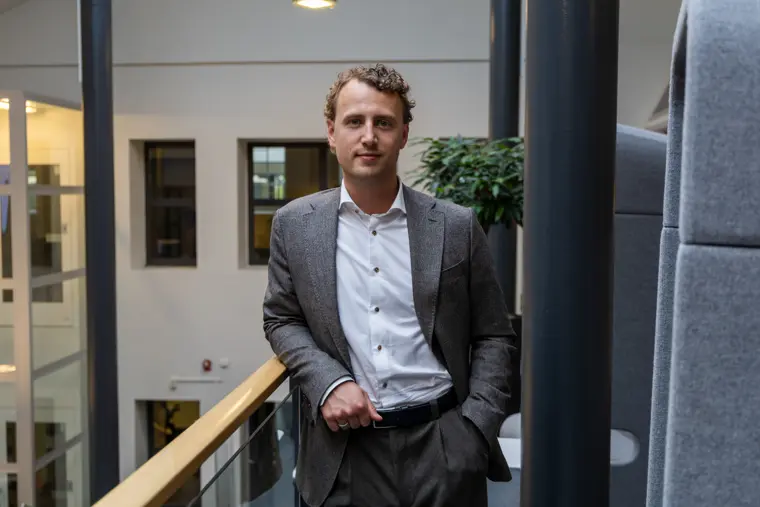
– I wanted to develop further, not only in my role but also in terms of my knowledge and skills. In the future, I want to have more of an influence on how an organisation develops, and I felt I needed a deeper understanding of how organisations are managed and developed.
Marcus Månsson chose the Master of Science in Marketing. One of the main reason was its focus on sustainability and the opportunity to combine this with strategy, value creation and business development.
– Sustainability is highly relevant to every organisation today. The opportunity to deepen my knowledge of business administration while learning more about how organisations create value and work strategically was a big part of what attracted me to the programme.
From sustainable coffee production to crisps in Åland
Sustainability was a key theme throughout the programme. Marcus explored areas including organisation and sustainability, industrial marketing and innovation. For his master's thesis, he worked with a fellow student from the Netherlands to study sustainable coffee production.
– As a coffee lover, it was a perfect topic for me. Coffee production is far from sustainable in many cases, and it was interesting to gain a deeper understanding of the challenges involved and how organisations can work towards more sustainable production.
"It was valuable to get hands-on experience in an actual organisation."
As part of the programme's work-integrated learning (WIL), Marcus and two fellow students worked with Rosenqvists Food Technologies in Kristianstad, a company that develops equipment for the food processing industry. Their project explored how crisp production could become more sustainable and energy-efficient – and even took the group to one of the company's customers in Åland.
– It was valuable to get hands-on experience in an actual organisation rather than focusing only on academic and conceptual work. The company was generous in sharing its expertise, and we had the opportunity to see how they work with customers and other stakeholders to find more sustainable solutions.
New perspectives in an international classroom
Marcus also highlights the opportunity to study alongside people from different parts of the world. Their different experiences and perspectives led to discussions that gave him new ways of thinking about both business and sustainability.
– I learnt not only from the teachers and course material, but also from my fellow students. We had many interesting discussions with students from different parts of the world and could look at the same issue in completely different ways. It gave me perspectives I wouldn't otherwise have had.
"The programme has given me a more critical perspective on sustainability, which I know will be useful both professionally and in my personal life."
Another thing Marcus takes with him is a stronger ability to question and analyse, particularly when it comes to sustainability.
– The programme has given me a more critical perspective on sustainability, which I know will be useful both professionally and in my personal life. I think being willing to challenge your own way of thinking is important if you want to drive change and create real value.
Ready for the next step
After graduating, Marcus Månsson is continuing in his role as a banking adviser at Sparbanken Skåne, a job he enjoys. At the same time, he feels ready to take on greater challenges and responsibilities in the future.
– I want to stay close to the business while combining that with analysis, strategy, sustainability and development. In the longer term, I want to build a broader understanding of business and take on greater responsibility for how an organisation develops.
"Just go for it."
His advice to anyone considering the master's programme is straightforward.
– Just go for it. If you know it will take you closer to where you want to be, I think you should apply. The programme has made me feel more prepared to take on roles that I previously didn't have enough knowledge or experience for.