
Studying with a disability
If you have a medically documented, long-term disability, such as ADHD, dyslexia or impaired vision for example, you may apply for targeted educational support. On this page, you can read about how to apply for targeted study support and see examples of common support measures.
Who can get study support?
A disability is considered long-term if it has existed, or is expected to exist, for at least six months. Long-term disabilities may include:
- neurodevelopmental disorder
- dyslexia
- mental ill-health
- visual or hearing impairments
- mobility impairments
- chronic illness.
If you need a sign language interpreter or an educational interpreter, contact us as soon as possible at samordnare.stod@hkr.se
Required Documentation for the Application
You must have valid documentation that confirms a permanent disability. The documentation must be written by, a qualified professional, for example a doctor, a speech therapist, an audiologist or a psychologist. In the case of dyslexia, the documentation can also be written by a special education teacher.
- The issuer's contact details, name, qualifications, position, or title
- How long you have had the disability or healthcare contact for the problem. The permanence of the condition is important.
- The date of issuance.
- How long the disability is expected to last.
- Description of the disability and how it affects you.
If the certificates are translated, they must be in Swedish, a Nordic (minority) language or English. For certificates regarding dyslexia, the documentation may be approved by a certified dyslexia assessor or a special education teacher. The certificate must include results from relevant standardized tests.
Notification of disability study support from other institutions of higher education cannot be used as documentation to prove your permanent disability.
If you have a visual, hearing or mobility impairment, you must contact the coordinator as soon as you receive your admission notice.
If you have a short-term injury or illness you should contact the examiner for the course in question.
Apply for support
Apply for targeted study support at www.nais.uhr.se.
If you have a protected identity, your first step must be to contact a coordinator, who will help you with your application: samordnare.stod@hkr.se.
Watch the video below for information on how to submit your application. There are subtitles in English. If you prefer to read the instructions, you can log in and follow them at www.nais.uhr.se.
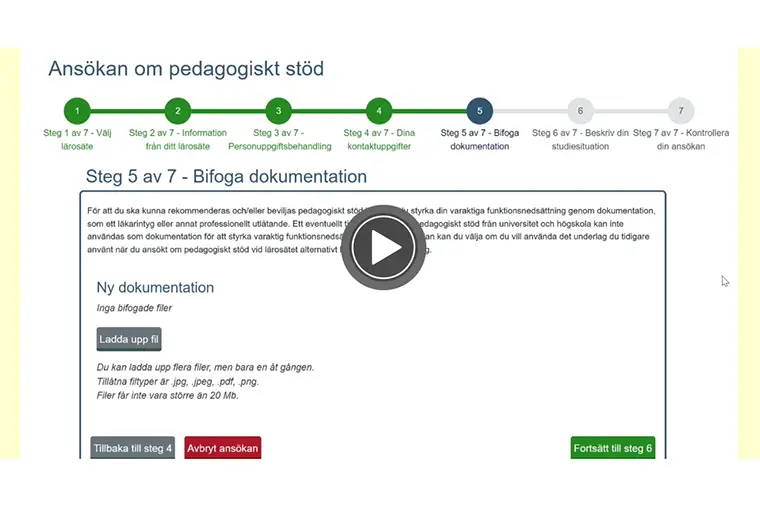
Please apply for targeted pedagogical support on www.nais.uhr.se.
How to find your certificate in targeted study support
Here you can watch a video on how to find your decision on support:
If you are enrolled in commissioned education
If you are taking a commissioned course, you too can apply for support via www.nais.uhr.se. Follow the instructions and attach a signed document from, for example, a doctor, psychologist, speech therapist, or audiologist confirming a permanent disability, indicating how long it is expected to last, and how it affects you.
It is important that you inform the coordinator that you are enrolled in a commissioned course.
Some employers arrange educational support themselves, so check this with your employer as well.
After you have submitted your application
You can book a meeting with the coordinator for students with disabilities via this web service (requires log on with HKT student account). If you do not do so, you will be contacted one of us.
Have a computer or mobile phone available during the meeting, as we will go through relevant links and you will usually receive a decision on support directly at www.nais.uhr.se.
It may be useful to read through the suggested targeted educational support listed below before your meeting with the coordinator.
What support can students receive?
The support you may receive depends, among other things, on your disability and what is feasible within your programme.
Educational interpreting
If you need a sign language interpreter or an educational interpreter, contact us as soon as possible at samordnare.stod@hkr.se.
Support in teaching situations (examples):
- Adjustments for group work.
- Access to teaching materials in advance.
- Individually adapted study plan.
- Audio recording for personal use.
Adjustments in written examinations (examples):
- Computer.
- Computer with text-to-speech.
- Computer with spell-check when language proficiency is not being assessed.
- Extended writing time.
- Medical equipment.
- Dictating exam answers.
- Exam questions in paper format.
- Sitting the exam in a smaller group.
Adapted forms of assessment following examiner’s decision (examples):
- Splitting an assessment into two or more sessions.
- Formula sheets.
- Extended time in oral examinations.
- Extended time for take-home exams.
- Extended time for written assignments.
- Calculator.
- Oral examination as a complement to written work.
Personal support
Personal support involves assistance from another person. See the sections below for more information.
Note-taking support
Note-taking support means that a fellow student shares their notes from lectures and seminars you yourself attend; it does not replace attendance. It is only provided if a fellow student takes on the task. Alternatively, you may receive permission to make audio recordings of lectures for personal use.
Mentoring
Students with reduced executive functioning may receive mentoring for a limited period to help plan and structure their studies, provided a suitable mentor is available. The aim is for you to develop routines you can maintain independently. The mentor is an experienced student at the university.
You meet the mentor online once a week if you study full-time, and once every two weeks if you study 15–29 credits.
Writing assistance
Students whose disability makes writing by hand or on a computer very difficult may be recommended writing assistance during examinations. The assistant writes what you say but may not explain terms or help with exam questions.
Support for visual impairment
Support for visual impairment involves providing assistance during visually demanding elements of teaching where technical aids are insufficient.
Guiding assistance
Students with severe visual impairment may, for a limited period—for example at the start of their studies—receive guiding assistance. A fellow student accompanies you to unfamiliar locations. If you need help learning frequently used routes, contact the coordinators.
Educational interpreting
Students who need sign language, written, or deafblind interpreting may apply for this in study-related contexts. For questions about educational interpreting, contact the coordinators at samordnare.stod@hkr.se
Studying abroad with a disability
If you have a long-term disability and receive support during your studies at Kristianstad University, you can also receive support while studying as an exchange student.
Read more at Exchange studies, English | HKR.se and contact marie.g.ekstrom@hkr.se
If you need a certificate of recommended support, contact samordnare.stod@hkr.se
Talking books and other support at Kristianstad University
- Please contact a librarian regarding talking books/adapted: biblioteket@hkr.se
- All students can access software for reading and writing free of charge via Läs- och skrivstöd för studenter och personal vid HKR | HKR.se. For support: se-support@everway.com (The webpage is to be translated)
- All students can receive support through the www.hkr.se/academic-skills
- Counsellors can be reached at www.hkr.se/student-health
- Study and career advisers can be reached at www.hkr.se/studycounselor
Exchange students
Please contact the coordinator at your home university to discuss the possibity of receiving study support during you studies here at Kristianstad university.
Independent students/Master's students
Please contact us to let us know that you are going to study at Kristianstad University and apply as soon as possible at www.nais.uhr.se
Non-study-related support
Targeted educational support applies to teaching and assessment only. The university therefore does not provide personal assistance, transport services or individual assistive devices.
Responsibilities of the municipality and of the region
Transport services, parking permits, housing adaptations, personal assistance, home care and personal assistive devices are administered by the municipality or the region. Higher education institutions are responsible solely for basic support in the study situation.
Below are instructions on how to apply for targeted educational support. The next section begins with a film showing how to locate your Nais notification.
Appeals
If you receive a rejection and consider it to be in violation of the prohibition of discrimination in Chapter 1, Section 4 (3) of the Discrimination Act (2008:567), the decision may be appealed to the Higher Education Appeals Board.
In the appeal, the student must state:
- which decision they wish to have changed.
- the date of the decision.
- the amendment they are requesting.
- name.
- personal identity number.
- address.
- telephone number.
When Kristianstad University receives an appeal, it first checks whether it has been submitted within the required time. If it has, the university assesses whether the decision can be changed in accordance with the student’s request. Regardless of whether the decision is altered or not, the case is forwarded to the Higher Education Appeals Board, which then notifies the student of its decision.